
'Why not ask for a change of leadership in Qatar, Bahrain or Saudi Arabia? Is there a constitution in Saudi Arabia? Are there elections in Saudi Arabia? Why no talk of democracy in these countries?' 'America said change the leader now, but is now ignoring the feelings of the Syrian moderate majority. Is that democracy,' asks H E Dr Riad Abbas, Syrian ambassador to India, in an interview to Cleo Paskal.

'Its internal economic rot and corrupt political elite have made the resurgent supremacy of the military establishment more invincible,' says Sunil Sethi.

'Pakistan has responded with appropriate contempt -- hrowing our national dignity into the waste paper basket.'
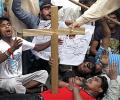
Two suicide bombers rammed into the All Saints Church in the Kohati Gate area of Peshawar, Pakistan, when Prime Minister Nawaz Sharif was on his way to New York to attend the United Nations General Assembly session.

A round-up of our favourite photographs from the week gone by.

Rebuffed by the Obama administration on its effort to seek US intervention on Kashmir, Pakistan has said that it has never made such a "demand" and just presented its wish list to Americans on the issue.

Swaraj expressed satisfaction over the agenda of the inaugural dialogue while giving the details of the deliberations.

It would be foolish for Pakistan to assume that India would not act no matter what the provocation is, just because it is militarily more powerful than Myanmar and is armed with nuclear weapons, says Anand Kumar.

'Diplomatic engagement will continue even as India keeps all its options open with respect to discretely targeting the Pakistani military and its terrorist proxies.'

'A close look at the time-lines tells you that exactly as the back-channel negotiations were in their most crucial stage, "somebody" was planning the 26/11 attacks in Mumbai,' says Shekhar Gupta questioning Khurshid Mahmud Kasuri's account of a peace deal with India.

Hein Kiessling has the kind of access in Pakistan that journalists (and spies) would die for, says Kanika Datta.

Saudi Arabia relies more heavily on migrant labour than any other large country.
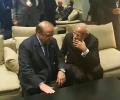
How the two South Asian neighbours will interact with each other in the coming months will be decided by the two prime ministers in Washington.

Indians want change and progress. They should be willing to accept tough decisions, says Sanjeev Nayyar.

The India card is now almost obsolete. There are more pressing challenges. People of Pakistan are fed up with years of bad governance, corruption and broken promises of successive governments. However, the politicians and former generals are still provoking sentiments on what is happening on the Line of Control for petty political gains, says Shahzad Raza.

'What needs to be pursued as the operations progress is a degree of reconciliation amongst the other parties, less the more orthodox Al Qaeda affiliates.'

'A collapsing Pakistan may well unleash its nuclear weapons as the last throw of the dice. With a nuclear arsenal of over 50 bombs, even a regional nuclear exchange can devastate the world.'

The known unknowns in Prime Minister Modi's Saudi visit assume great significance, says Ambassador M K Bhadrakumar.

'The Left is dying, but its economic ideology rules, unchallenged.' 'Modi is its newest standard-bearer.' 'Even in today's bitterly polarised politics, if there is one thing on which not just the BJP and Congress, but all other parties agree, it is that socialist economics is the only way to survive,' says Shekhar Gupta.

How to deal with a country that has made export of terror a reason to make the world notice and fund it? Rediff.com contributor Sanjeev Nayyar offers a few suggestions
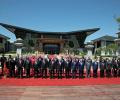
'Whichever option India chooses, it should be clear to the government that the China-Pakistan nexus poses a clear and present danger to national security,' says Brigadier Gurmeet Kanwal (retd).

'Openness is a great weapon in the armoury of more open societies. That's why the fight with Pakistan isn't just about India be six times bigger, but equally bitter and insecure Pakistan,' argues Shekhar Gupta.
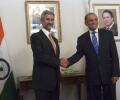
Pakistan's holy trinity -- its government, military establishment and the ISI -- differ on Pakistan's domestic and foreign policy issues. So when India talks to Pakistan's political leadership it can't be sure that the promises can be delivered, says Brigadier S K Chatterji (retd).

India and Russia are involved in talks to sort out the nuclear liability issues before they sign an agreement for setting up Units III and IV of the Kudankulam power plant in Tamil Nadu during Prime Minister Manmohan Singh's annual summit with President Putin in Moscow next week.
Prime Minister Narendra Modi's initial weeks in office and the composition of his national security team give a sense of his government's foreign policy and national security priorities, says Harsh V Pant

'In India foreign policy is generally handled by the prime minister.' 'One can clearly see the Vajpayee stamp on all this.' 'Only a person with poetic imagination can weave such a complex web,' says Colonel Anil A Athale (retd).
Separatists and their wide network must be neutralized for peace in the Valley
'Let people across the LoC see the resolve of Bharat and the contribution of the Indian Security Forces in rebuilding the Valley. Let disaster become the rallying point for integration -- not only of society but also of all the instruments of State,' says General Anil Chait (retd).

It is time to throw an outer ring around India's national security by proactively engaging in areas immediately outside our neighbourhood. Such a ring will not only insulate India from emerging threats, but also create new leverage in securing our own neighbourhood, says Nitin Pai.

'If you invest your entire capital in talks, you cannot abruptly change gear and decide on war.'

Admiral Sam Locklear heads the US Pacific Command, making him the most powerful military commander on earth. With 60 per cent of the US Navy under him, PACOM oversees 52 per cent of the planet. Locklear is America's military pointsman for 36 countries, including India and China.

'I am no longer surprised by how cynical university students generally are about American motives. America, no matter who the President, what the circumstances will act like a bully, is their collective belief,' says Ambassador B S Prakash after a recent interaction with students.
'The attack on the Pathankot base constituted an act of war. Yet Modi's only public comment up until now on that attack has been to blame it on "enemies of humanity".' 'Modi came to power talking tough about Pakistan. But in office, he has pursued a Pakistan policy that has lost both direction and purpose,' argues Brahma Chellaney.
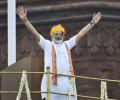
Following is the full text of Prime Minister Narendra Modi's address from the ramparts of the Red Fort on the 73rd Independence Day.

'Since India has to live next to Pakistan, it can't remain under permanent blackmail.' 'A predictable consequence of these fundamental shifts is the fraying of the principle of strategic restraint.' 'It hasn't been junked. But the threshold has been shifted to provide India much greater room for retaliatory action,' says Shekhar Gupta.

'How can Kashmir be demilitarised if the terrorist threat remains and Pakistan continues to incite elements in Kashmir to keep the internal situation unstable?' asks former foreign secretary Kanwal Sibal.

'So you have a middle class, and an elite that have seceded into outer space and they look down and say, "What's our bauxite doing in their mountains?" and "What's our water doing in their rivers?" There's a sense of entitlement there.' Arundhati Roy captures minds with her thoughts on capitalism, Indian politics, war, and more in New York.

'Castro told us: "Give me a thousand Gurkhas and I shall keep my neighbour under control!"' 'We pretended that we did not know which neighbour he meant.'
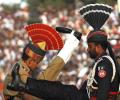
'Despite Modi's high-flown rhetoric about good-neighbourly relationships in South Asia, he lacks a road map how to proceed -- be it with Bangladesh or with Sri Lanka and Pakistan... But a deeper question arises here: Did he duck on his own accord or under the diktat from the RSS, asks Ambassador M K Bhadrakumar.

'The defence minister needs to focus on human resources-related issues at the same pace in 2017 as he did on acquisitions in 2016,' says Brigadier S K Chatterji (retd).
